Recorded Course · Philosophy Portal
Hegel's Phenomenology of Spirit Course
Thinking dialectical form for our time.
8 sessions
30+ hours
Lifetime access
Why read the Phenomenology today?
The Phenomenology of Spirit is considered one of the most challenging texts in Western philosophy. So why spend hours and hours laboring through this enormously dense and abstract text?
The truth is that it's going to be a challenging experience. The reason why you should read this book is because it represents a genuine historical break from the past and also casts an enormous shadow on future thinkers. Yet it continues to resonate today for several reasons:
The Phenomenology of Spirit is not simply a history of ideas. It is a map of consciousness
The stages Hegel describes are not simply abstract philosophical categories. They trace different ways in which human beings come to understand themselves and the world.
Reading the Phenomenology with Philosophy Portal therefore means learning to think through contradiction, to question what appears self-evident, and to understand how our ways of seeing ourselves and the world are continually shaped and transformed through experience.
Behind this philosophical journey lies a question that remains deeply contemporary: How can one become oneself while accepting that the self is a perpetual process of transformation?
Key concepts you'll explore
-
Consciousness
Explore how consciousness encounters the world, from immediate sensory certainty to increasingly complex ways of understanding what appears before us.
-
Self-Consciousness
Understand the moment when consciousness turns toward itself — and discovers that knowing oneself is inseparable from encountering other selves.
-
Recognition
Explore why we depend upon others to become who we are, and how recognition gives rise to struggles over independence, dependence and power.
-
Reason
Follow consciousness as it attempts not only to understand the world rationally, but to find and realize reason within the world itself.
-
Spirit
Discover how individual consciousness is embedded within something larger: shared cultures, institutions, ethical life and the historical worlds we collectively create.
-
Religion
Explore religion as a stage in Spirit’s attempt to represent and understand itself, from natural and artistic forms to revealed religion.
-
Absolute Knowing
Understand the culmination of the Phenomenology: not as knowing everything, but as consciousness grasping the historical process through which its own knowledge has become possible.
-
Dialectics
Understand how contradictions emerge within ideas and forms of life — and how, for Hegel, confronting these contradictions becomes the driving force of thought and transformation.
-
History
Discover why thought is never separate from history, and how consciousness, culture and forms of knowledge develop through historical processes.
This is an invitation to enter a way of thinking — and to test what Hegel’s dialectical philosophy can still make visible in the present.
Detailed program
8 sessions combining close reading and open discussions
-
The opening session situates the Phenomenology of Spirit within Hegel’s philosophical project and introduces the intellectual landscape that emerged in its wake — from thinkers who extended Hegel’s philosophy to those who defined themselves against it.
The session then turns to J. N. Findlay’s Foreword as a first map of the Phenomenology. It introduces three major themes that will guide the course: the historical development of Spirit, the movement from immediate experience toward philosophical knowledge, and the necessity of what Hegel calls Absolute Knowing.
-
This session turns to Hegel’s own Introduction to the Phenomenology of Spirit.
Participants explore Hegel’s critique of conventional models of objective knowledge and his relationship to two decisive intellectual frameworks: Newtonian science and Kantian idealism. From there, the session introduces Hegel’s distinctive conception of scientific cognition.
The second part examines the Absolute, first as something considered “in itself” and then from the perspective of the phenomenological journey itself.
The session concludes with a collective discussion of the Introduction and the problem that will accompany the entire Phenomenology: what would it mean for consciousness to arrive at a form of knowledge capable of understanding both itself and its world?
-
The session follows the movement through Hegel’s three forms of Consciousness: Sense-Certainty, Perception and Understanding. Each initially appears to offer a more adequate account of reality, yet each encounters contradictions that reveal the limits of its own claims to knowledge.
The session therefore prepares one of the decisive transitions of the book: from consciousness of an object to self-consciousness. The question is no longer simply “What is the world?”, but increasingly “What is the consciousness for which this world appears?”
After these two major sections we open collective discussion on salient points related to the chapter on Consciousness.
-
The session begins with the struggle between subject and object before moving into the distinctly intersubjective struggle for recognition. Hegel explores how the desire to establish oneself as an independent self generates relations of dependence, opposition and power — opening some of the most influential passages of the Phenomenology.
The second part expands this struggle beyond the encounter between individual selves, examining the spiritual struggle of consciousness and ultimately its relation to the Absolute itself.
At stake is a question that will resonate throughout the rest of the book: can we truly become self-conscious in isolation, or does becoming a self always require a relation to something — and someone — beyond ourselves?
-
The session begins with Observing Reason: the attempt to discover rationality in nature, the world and the human psyche.
The course then turns from observation to the actualization of Reason, and includes discussions on embodiment, community ethics, and the spiritual quest caught between vice and virtue.
Finally, the session examines Hegel’s movement toward ethical substance, shared practices and law.
After these three sections we open collective discussion on salient points related to the chapter on Reason.
-
The session begins with the tensions between human and divine law, masculine and feminine roles, knowledge and ethical obligation.
The course then follows Spirit into the world of culture and alienation.
The second part examines the confrontation between faith and Enlightenment insight, before turning toward Hegel’s account of morality: the moral worldview, duty and conscience.
These developments ultimately prepare the transition from morality toward Religion, as Spirit searches for a form in which it can recognize and represent itself.
-
The first part follows Hegel’s account of Religion through three forms: Natural Religion, Religion in the Form of Art, and Revealed Religion.
The second part turns to the notoriously difficult idea of Absolute Knowing. Rather than presenting it simply as possession of a final set of truths, the session examines Absolute Knowing through self-knowledge, universality and, crucially, historicity.
-
The course concludes by returning to one of Hegel’s most celebrated — and demanding — texts: the Preface to the Phenomenology of Spirit.
Read at the beginning, the Preface can appear almost impenetrable. Read after travelling through the Phenomenology, its claims about truth, negativity, becoming and the Absolute acquire a different significance. This final session therefore uses the Preface to reconsider the philosophical movement of the course as a whole.
The course closes with a collective Q&A, bringing the central principles of the Preface into conversation with the journey through the book as a whole — and returning to the question with which the course began: what does it mean to think dialectically?
Course extract
Watch an extract from the Phenomenology of Spirit course and see how Philosophy Portal approaches close reading, dialectical thinking and collective philosophical inquiry.

About the Professor
Why study Hegel with Cadell Last?
Dr. Cadell Last is the creator and founder of Philosophy Portal, an educational platform dedicated to teaching the foundational philosophical discourses of the modern world.
His engagement with Hegel is part of a much broader intellectual project. Trained across evolutionary anthropology, systems science and philosophy, Cadell approaches philosophical texts from an interdisciplinary and dialectical perspective. His work repeatedly returns to questions that are also at the heart of the Science of Logic: how concepts develop, how contradiction generates new determinations, how thought relates to objectivity, and how logic opens onto questions of knowledge, freedom, life, and the structure of reality itself.
A continuing engagement with Hegel
The Phenomenology of Spirit is part of a broader exploration of Hegel’s philosophy at Philosophy Portal. Continue your journey with Cadell Last through two other major works: the Science of Logic, exploring the structure and movement of dialectical thought, and the Philosophy of Right, where Hegel turns to freedom, social life, politics and the modern state.
From the course to a living philosophical conversation
The Phenomenology of Spirit course did not end with its final session. It became the starting point for a wider collective inquiry into what it might mean to think with Hegel in the 21st century.
Following the course, Philosophy Portal brought together a diverse group of participants and thinkers for a conference dedicated to extending the questions of the Phenomenology beyond the text itself. The recording of the conference is available here.
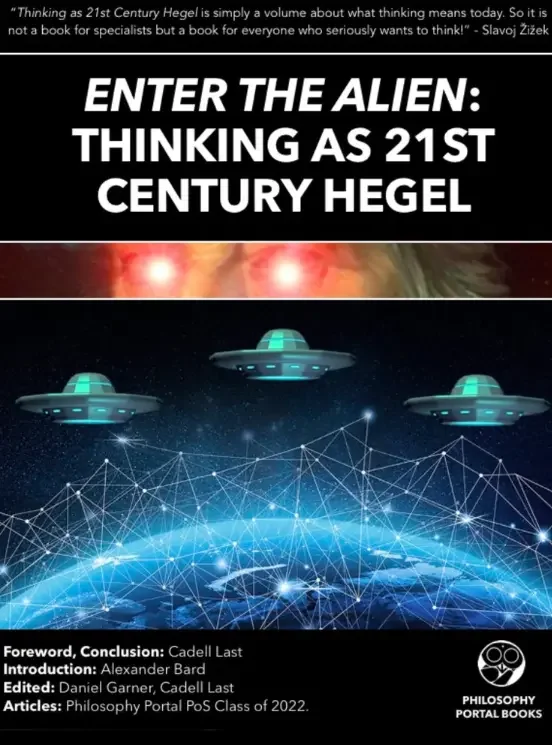
Enter the Alien: Thinking as 21st Century Hegel
The conversations surrounding the course and conference eventually developed into Enter the Alien: Thinking as 21st Century Hegel, published by Philosophy Portal Books in 2022.
To learn more about the anthology, click here.
AI CAN SUMMARIZE HEGEL. WE READ HIM.
Go beyond the summary
AI can summarize a book, explain a concept or answer a question in seconds. What remains rare is a space in which people can think collectively and over time. Philosophy Portal is built to be that space.
Our courses are designed around close reading and sustained engagement with the text itself. Rather than offering another introduction to Hegel, Nietzsche, Lacan or Marx, we work through major philosophical texts in depth — following their arguments, concepts and contradictions as they unfold.
Join a community, not just a classroom
Taking a Philosophy Portal course is also a first entry point into a wider intellectual community. We connect courses, reading groups, events, conferences and an international philosophical community into a growing ecosystem of thought. You can take a look at what The Portal - our live philosophycal community - does here.

HEGEL’S PHENOMENOLOGY OF SPIRIT
Follow consciousness.
8 sessions
30+ hours
Lifetime access
Work through one of the philosophy’s most demanding texts with a guide